Where Garlic and Onion Hide on US Food Labels
If you train hard and eat a lot of packaged food, garlic and onion end up in more of your meals than you would guess. For anyone cutting back on fructans, that matters. A gastroenterology review in Gastroenterology & Hepatology lists garlic, onion, shallot and leek among the high-FODMAP foods, with fructans as the reason [1]. In a USDA survey of more than 15,000 Americans, onions supplied about a quarter of the inulin and oligofructose (two kinds of fructan) that occur in food by nature [2].
The powder deserves the closest look. A 2024 lab study measured onion at about 2 g of fructans per 100 g fresh, and about 16 g per 100 g of dry matter [3]. Drying takes the water out and leaves the fructans in a smaller package, and garlic and onion powder are made by drying.
If you have ongoing gut symptoms, see a doctor or a registered dietitian before you change your diet.
Do "natural flavors" contain garlic or onion?
The answer turns on which agency regulates the food, and the package shows you which one.
FDA foods: garlic and onion powder must be named
Most packaged foods fall under the FDA. Its rules define "spice" in a way that leaves out onions and garlic, because the rule counts them as foods by long tradition [4]. The same section says powdered or granulated onion and garlic powder are understood to be food rather than flavor and "shall be declared by their common or usual name" [4]. FDA rules also require a specific name for each ingredient, and a blended ingredient such as a seasoning mix gets its own ingredients listed in parentheses [5].
On an FDA-regulated snack, sauce or vegetable broth, that means "spices" can't stand in for garlic or onion, and garlic powder can't sit inside "natural flavor." One gap remains. The FDA's definition of natural flavor includes essences and extracts made from vegetables [4], so a flavor could still come from garlic or onion in extract form.
USDA foods: meat, poultry and meat broth
Meat and poultry products fall under the USDA's Food Safety and Inspection Service (FSIS), and its rules give labels more room. FSIS regulations also leave onions and garlic out of "spice," but they add that "natural flavor," "flavor" or "flavoring" "may also be used to designate spices, powdered onion, powdered garlic, and powdered celery" [6][7]. FSIS consumer guidance lists onion powder, garlic powder, onion juice and garlic juice among the ingredients a label can declare as "natural flavor," "flavor" or "flavoring" [8].
That rule covers sausages, deli meat, jerky, meatballs, seasoned chicken and meat or poultry broth made under USDA inspection. FSIS policy exempts stocks and broths made with small amounts of meat or poultry, along with bouillon cubes, from USDA jurisdiction [9], which leaves them under FDA rules.
You can spot a USDA product by its inspection mark. Inspected meat labels must carry an official inspection legend, and the poultry version reads "Inspected for wholesomeness by U.S. Department of Agriculture" inside a circle [6][10]. When you see that mark and the ingredients list says "flavor," "flavoring" or "natural flavors," garlic or onion powder could be inside those words.
Where do garlic and onion hide on food labels?
Check these four aisles first.
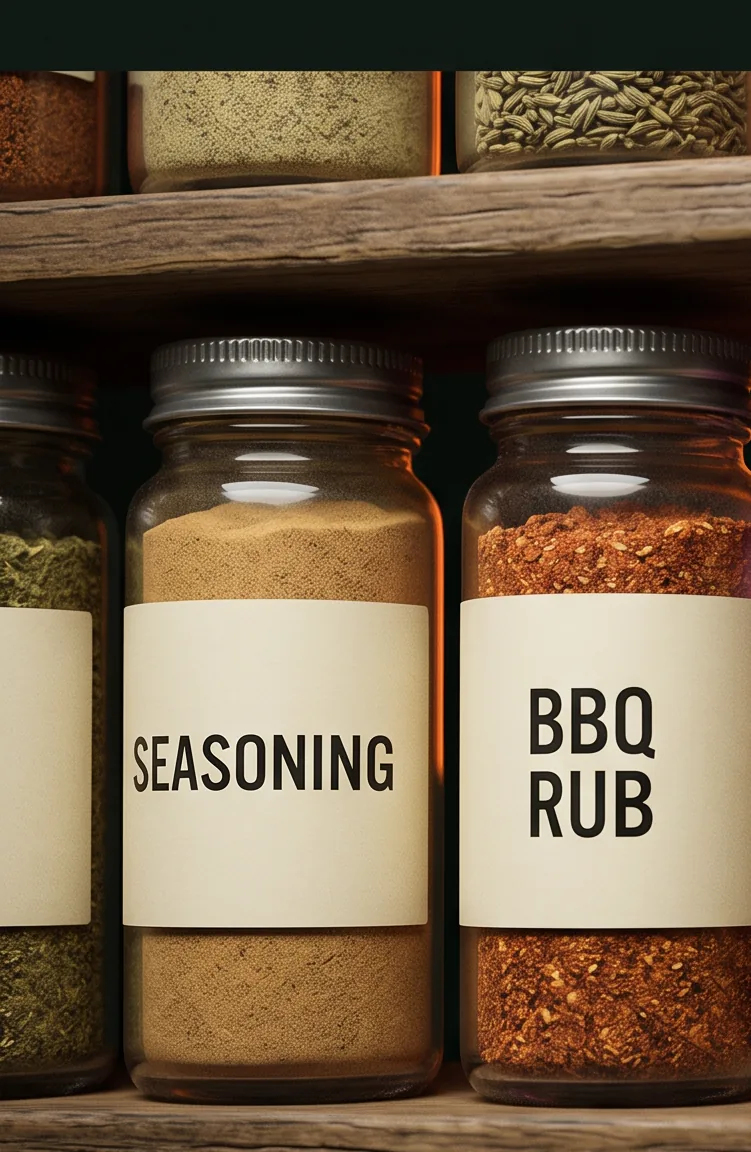
Seasoning blends and rubs. Read a blend ingredient by ingredient. FDA rules make the maker name garlic and onion powder in a blend, so the list gives you a straight answer [4][5]. Garlic salt and onion salt count as garlic and onion.
Stock, broth and bouillon. Chicken and beef broth made under USDA inspection can carry garlic or onion powder inside "natural flavor" [7][8]. Vegetable broth and bouillon cubes follow FDA rules, so look for the words garlic and onion themselves.
Sausages, deli meat and jerky. These are FSIS products, so "flavoring" or "natural flavors" on the list leaves garlic or onion powder on the table [6][8]. A label that names garlic powder outright settles it.
Sauces, marinades and dressings. Sauces with no meat in them are FDA foods, so garlic and onion must appear by name [4]. A meat sauce or gravy can fall under the USDA, so check it for the inspection circle before you trust a plain "flavoring."
Is garlic-infused oil low FODMAP?
Garlic-infused oil is the standard workaround, and the same review lists it as a substitute for onion and garlic [1]. The chemistry explains why. Fructans are water-soluble carbohydrates with a strong attraction to water [11], which is why cooks expect the oil to pick up garlic's flavor while the fructans stay in the garlic. Strain out the solids before you use the oil, because the garlic pieces still hold their fructans.
Homemade garlic oil needs care. The CDC says to refrigerate homemade oils made with garlic or herbs and throw them away after 4 days [12]. If you would rather skip that, buy a bottled garlic-infused oil whose label lists oil and garlic flavor or extract, with no garlic pieces in the bottle.
For onion flavor, use the green tops of scallions and leave the white bulbs out, or use chives. Both sit on the lower-FODMAP side of that review's food table [1]. A garlic replacer or a garlic-free seasoning blend deserves the same label check as any other blend, which means no garlic, onion, shallot or leek in any form.
A 20-second label routine
- Skip the front and find the ingredients list. Words like "natural" and "clean" tell you nothing about garlic or onion.
- Scan for four names. Look for garlic, onion, shallot and leek in any form, including powder, granulated, dried, dehydrated, minced, salt, juice or extract. They count wherever they sit, last place included.
- Look for the USDA inspection circle. If you find it, count "flavor," "flavoring" and "natural flavors" as a possible source of garlic or onion powder [8].
- Without the circle, read "spices" as spices. Under FDA rules, "spices" can't include garlic or onion, and the powders have to be named [4].
Makers change recipes, so read the list again when a package gets a new look.
The free Label Cheat Sheet puts this routine on one page, along with the other flags to scan for, such as added inulin, sugar alcohols and lactose. If you would rather skip the label reading at dinner, The Build Plan and The Lean Plan give you low-FODMAP, gluten-free meals with the portions measured for training.
Read any label in 20 seconds
The free Label Cheat Sheet shows the six words to scan for on a food label, and what to buy instead.
Get the free cheat sheetSee the meal plansFAQ
Can natural flavors contain garlic?
Yes, on meat, poultry and USDA-inspected broth, where garlic powder, onion powder and their juices can be declared as "natural flavor" or "flavoring" [7][8]. On FDA-regulated foods, garlic and onion powder must be named, though a natural flavor can still include plant extracts [4].
Is garlic powder low FODMAP?
No. Garlic is on the high-FODMAP list because of its fructans [1], and garlic powder is garlic with the water removed. Garlic-infused oil gives you the flavor without the garlic solids.
What can I use instead of onion powder?
Scallion greens and chives cover onion flavor, and garlic-infused oil covers garlic [1]. For a dry seasoning, choose a blend whose label names no garlic, onion, shallot or leek.
Sources
- Magge S, Lembo A. Low-FODMAP Diet for Treatment of Irritable Bowel Syndrome. Gastroenterology & Hepatology (N Y). 2012;8(11):739-745 (Table 1).
- Moshfegh AJ, Friday JE, Goldman JP, Ahuja JK. Presence of inulin and oligofructose in the diets of Americans. Journal of Nutrition. 1999;129(7 Suppl):1407S-1411S.
- Ferjančič B, Korošec M, Kočevar Baloh A, Bertoncelj J. Fructan content in most commonly consumed Slovenian foods and estimation of daily fructan consumption. Frontiers in Nutrition. 2024;11:1446771 (Table 1).
- 21 CFR 101.22, Foods; labeling of spices, flavorings, colorings and chemical preservatives, paragraphs (a)(2), (a)(3) and (h)(3). eCFR.
- 21 CFR 101.4, Food; designation of ingredients, paragraph (b). eCFR.
- 9 CFR 317.2, Labels: definition; required features, paragraphs (c)(5) and (f)(1)(i). eCFR.
- 9 CFR 381.118, Ingredients statement (poultry products), paragraph (c). eCFR.
- USDA Food Safety and Inspection Service. Natural Flavors on Meat and Poultry Labels. Last updated Aug 9, 2024.
- USDA Food Safety and Inspection Service. Food Standards and Labeling Policy Book, "Amenability" entry. Revised Sept 8, 2025.
- 9 CFR 381.96, Wording and form of the official inspection legend. eCFR.
- Díaz-Ramos DI, Jiménez-Fernández M, García-Barradas O, Ortiz-Basurto RI, Fouconnier B. Chemical Modification Methods for Inulin- and Agavin-Type Fructans: A Review. Molecules. 2025;30(13):2672.
- Centers for Disease Control and Prevention. Botulism Prevention.